Private Japan Editorial
Curation Team
Beyond the well-trodden paths of Hakone and Beppu lies Tōhoku, Japan's northern frontier, where ancient hot springs bubble up through volcanic earth in villages that time seems to have forgotten. Here, the art of onsen bathing remains pure, unhurried, and profoundly connected to the land.
Nyūtō Onsen: The Milky Waters
Nestled in the mountains of Akita Prefecture, Nyūtō Onsen is a collection of seven ryokan, each drawing from different mineral springs. The waters here range from crystal clear to milky white, their opacity a testament to the rich sulfur content that has drawn bathers for centuries.
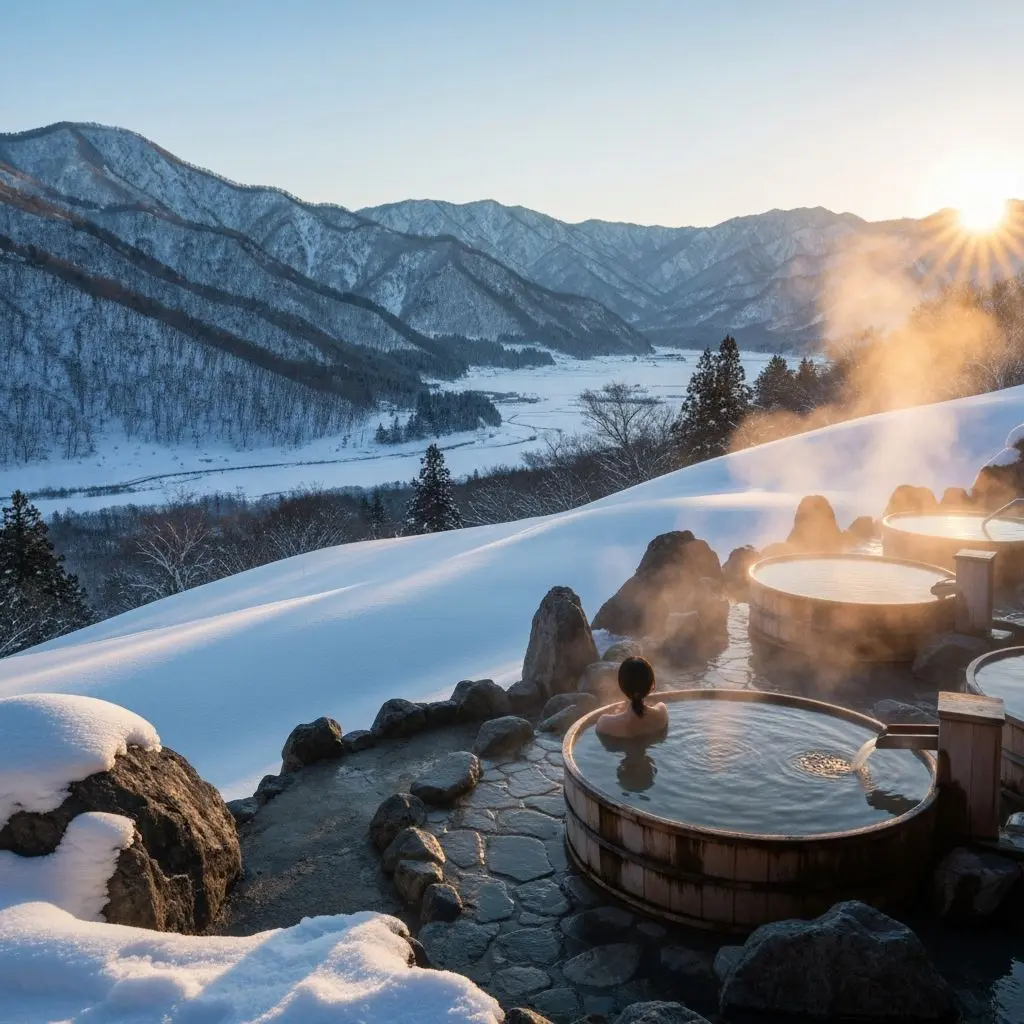
Tsurunoyu, the oldest of these establishments, dates to the Edo period. Its thatched-roof buildings cluster around a rotenburo (outdoor bath) where steam rises to meet the mountain air. In winter, when snow blankets the surrounding beech forests, bathing here becomes a meditation on the Japanese concept of yugen—mysterious depth.
Ginzan Onsen: Frozen in Time
If Tōhoku has a postcard moment, it is Ginzan Onsen at dusk. Gas lamps illuminate wooden ryokan that line both banks of a narrow river, their three and four-story facades reflecting in waters that steam in the cold air. The effect is ethereal, almost theatrical.
"The water knows the way. It has carved these valleys for millennia, and it continues to heal those who submit to its ancient wisdom."
Originally a silver mining town—ginzan means silver mountain—this village reinvented itself when the mines closed, embracing the hot springs that had always flowed beneath its streets. Today, strict preservation laws ensure that Ginzan remains suspended in the Taishō era, a living museum of early twentieth-century Japan.
The Etiquette of Solitude
What distinguishes Tōhoku's onsens from their more famous counterparts is not merely their remoteness but their rhythm. Here, bathing is not an activity but a state of being. Guests wake early to soak before breakfast, return after hiking, and conclude each day in contemplative silence as stars appear above the steam.
The local custom of toji—therapeutic bathing stays of a week or more—persists here. Visitors come not for tourism but for healing, following centuries-old traditions that recognize the waters' restorative powers for ailments both physical and spiritual.
For those we guide to these hidden waters, we arrange stays that honor this tradition. Our guests arrive not as tourists but as participants in an ongoing conversation between humans and the earth—a dialogue written in steam, stone, and silence.